
Why Your Wrists Are Screaming for Help (And What to Do About It)
Wrist pain exercises are one of the most effective ways to ease discomfort, restore movement, and prevent long-term damage — especially if you spend hours at a keyboard or mouse.
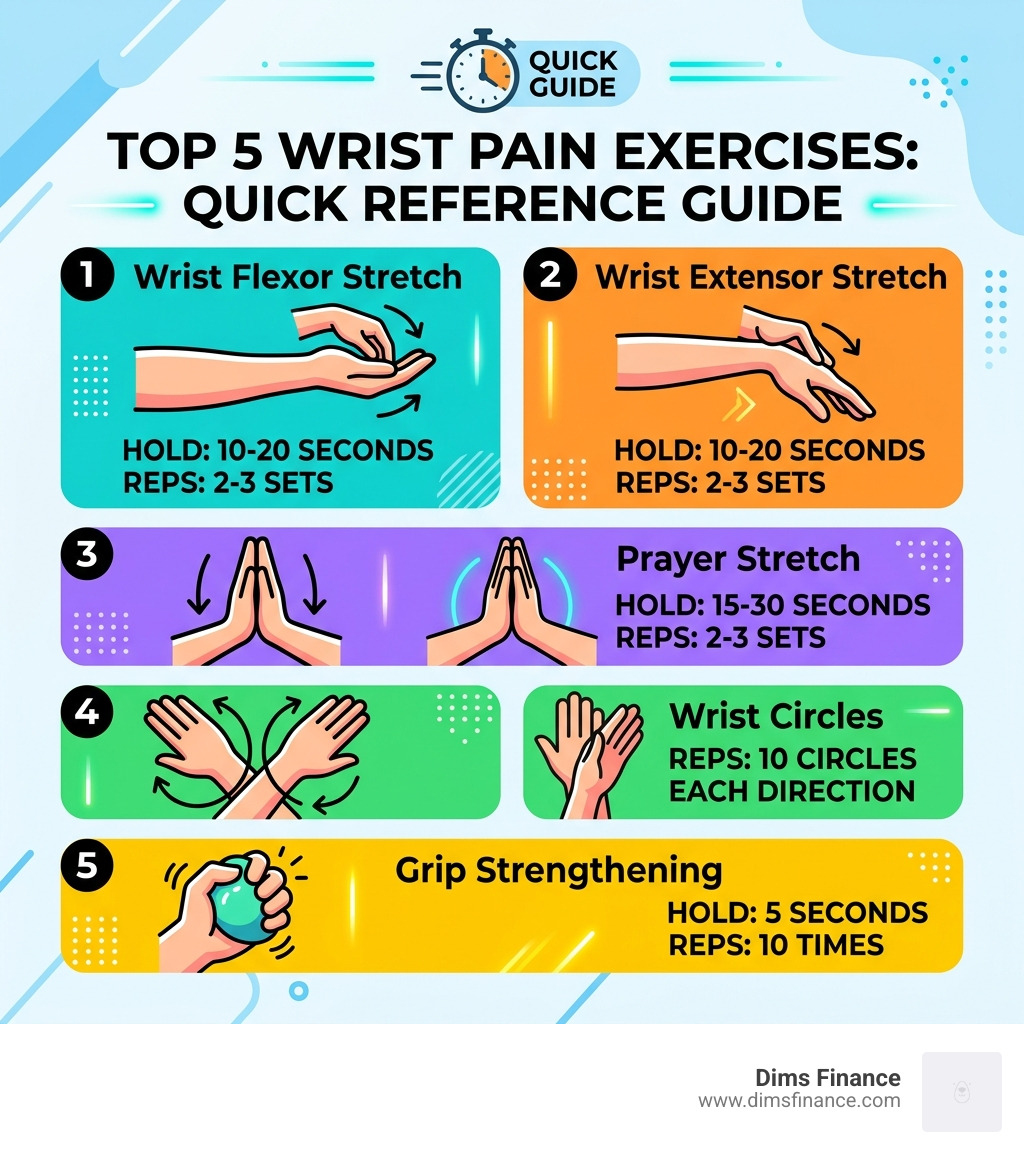
Quick answer — the best wrist pain exercises to start with:
- Wrist flexor stretch — extend your arm, palm up, and gently pull your fingers back with your other hand. Hold 10–20 seconds.
- Wrist extensor stretch — extend your arm, palm down, and gently pull your hand toward you. Hold 10–20 seconds.
- Prayer stretch — press palms together in front of your chest and slowly lower toward your waist. Hold 15–30 seconds.
- Wrist circles — slowly rotate your wrists clockwise and counterclockwise, 10 reps each direction.
- Grip strengthening — squeeze a soft ball or rolled towel for 5 seconds. Repeat 10 times.
Important: Only exercise if your pain is a 4 out of 10 or lower. Higher pain means it’s time to see a healthcare provider.
Maybe your wrists started aching after a long work session and you brushed it off. Or the pain crept in so gradually you barely noticed — until suddenly typing felt like a chore.
You’re not alone. Around one in two adults in the United States lives with a musculoskeletal condition, and wrist pain from repetitive strain is one of the most common culprits. For office workers and gamers, hours of typing and mouse use put the wrist tendons under constant, low-level stress. Over time, that stress causes inflammation, tightness, and lost range of motion.
The good news? You don’t need surgery or expensive treatment to start feeling better. Gentle movement and targeted exercises are often all it takes — but only if you do them correctly and consistently.
This guide walks you through exactly how.
Understanding the Root of Your Discomfort
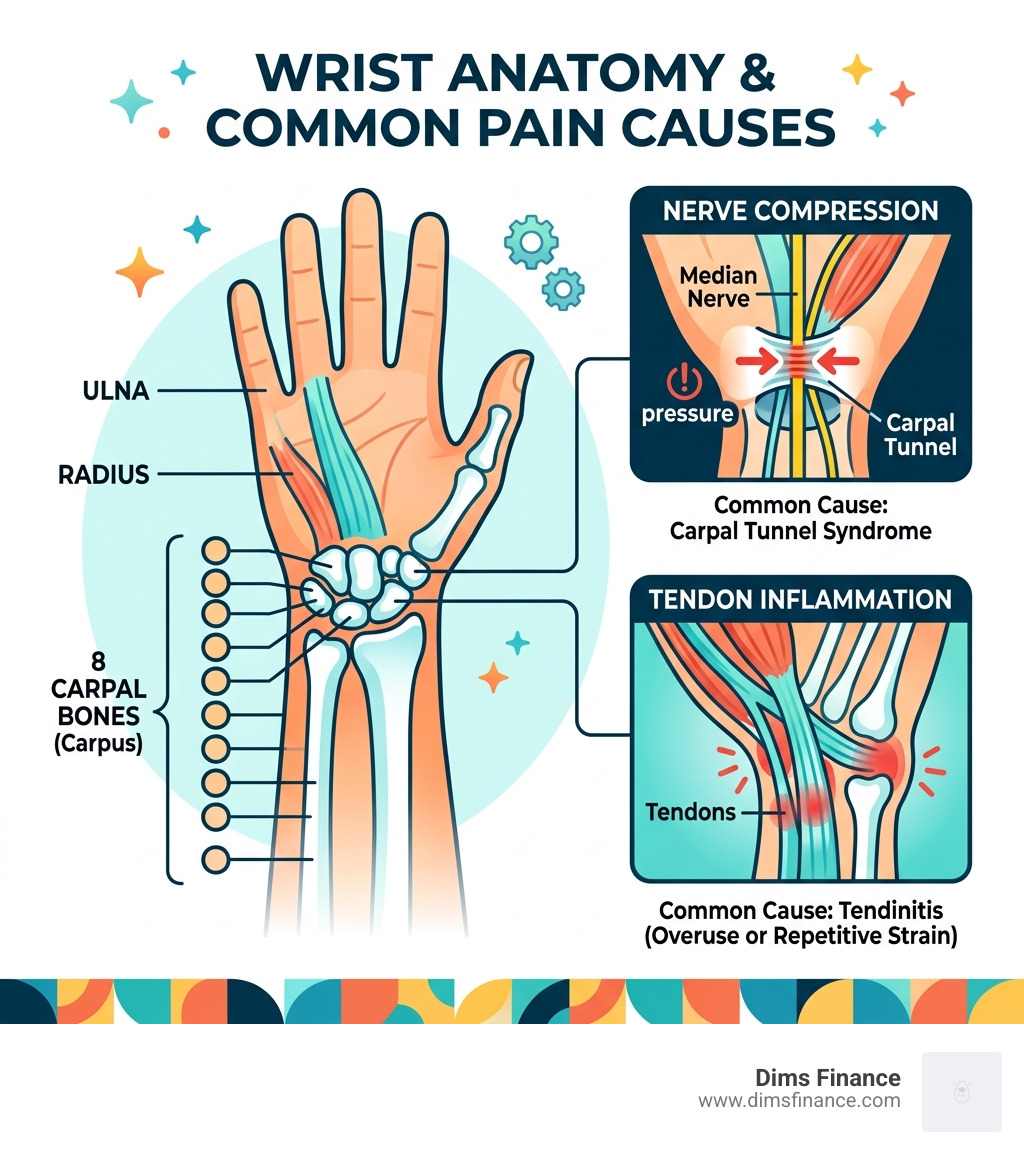
Before we dive into the movements, we need to understand why your wrists are protesting. Think of your wrist as a high-traffic intersection. It’s a small space where eight carpal bones, numerous ligaments, and dozens of tendons all meet to help you perform intricate tasks. When we overwork this intersection without giving it a break, “traffic jams” in the form of pain and inflammation occur.

Common causes of wrist pain include:
- Repetitive Strain Injury (RSI): This is the classic “office worker’s woe.” It happens when we perform the same small movements—like clicking a mouse or typing—thousands of times a day.
- Carpal Tunnel Syndrome: This occurs when the median nerve, which runs from your forearm into the palm of your hand, becomes pressed or squeezed at the wrist.
- Tendinitis (or Tendinopathy): This is the inflammation or irritation of the tendons. In the wrist, it’s often caused by overuse or sudden increases in activity volume.
- Trauma (FOOSH): Falling On an OutStretched Hand (FOOSH) is a leading cause of acute wrist injuries, including sprains and fractures.
In April 2026, we see more people than ever struggling with these issues due to our increasingly digital lifestyles. Interestingly, research shows that while we often blame the wrist itself, issues in the shoulder or elbow can actually force the wrist to “overcompensate,” leading to strain. Understanding this helps us realize that wrist pain exercises aren’t just about the joint itself; they’re about restoring the health of the entire arm.
The Best Beginner-Friendly Wrist Pain Exercises
If you’re currently feeling that dull, nagging ache, your first goal isn’t to build “Hulk-like” strength. Instead, we want to focus on range of motion, joint mobility, and tendon health. Think of these as “greasing the gears” of your joints.
Movement helps keep the synovial fluid (the joint’s natural lubricant) flowing and ensures that tendons can glide smoothly through their sheaths. According to experts, Wrist Pain: Exercises, Causes, and Treatment involves a balance of rest and active recovery.
Essential Stretches for Immediate Relief
These stretches are the “holy grails” of wrist health. They target the forearm muscles that do the heavy lifting during typing and lifting.
- Wrist Flexor Stretch: Extend your arm in front of you with the palm facing up. Use your other hand to gently pull your fingers down toward the floor until you feel a stretch in your inner forearm. Hold for 15–30 seconds.
- Wrist Extensor Stretch: Extend your arm with the palm facing down. Point your fingers toward the floor and use your other hand to gently press the back of your hand toward you. You should feel this on the top of your forearm.
- Prayer Stretch: Stand with your palms together in front of your chest, fingers pointing up (like you’re praying). Slowly lower your hands toward your waistline while keeping your palms pressed together. Hold for 30 seconds.
For a deeper dive into why these work, check out The Science Backed Guide To Rsi Prevention.
Range of Motion Wrist Pain Exercises
These exercises are designed to move the joint through its full natural path without adding heavy weight.
- Wrist Circles: Make a light fist and rotate your wrists in slow, controlled circles. Do 10 clockwise and 10 counter-clockwise.
- Side-to-Side (Ulnar and Radial Deviation): Place your forearm flat on a table with your hand hanging off the edge, thumb pointing up. Gently move your hand up (toward the thumb) and down (toward the pinky) as if you’re slowly waving.
- Hand Flips: Sit with your forearm resting on your thigh, palm down. Slowly flip your hand over so the palm faces up, then flip it back. Repeat 10–12 times.
Gamers, in particular, benefit from these high-repetition, low-load movements to offset the static positions held during long sessions. You can find more specific tips in How Gamers Can Prevent Repetitive Strain Injuries With Simple Exercises.
Strengthening Your Wrists for Long-Term Resilience
Once the initial “screaming” stops and your pain levels are consistently low, it’s time to build a fortress. Strengthening the muscles in your forearm provides better stability for the carpal bones and takes the pressure off your ligaments.

Strengthening isn’t just about lifting heavy objects; it’s about muscle control. As noted in 11 Exercises and Stretches for Wrist Pain, building this resilience can prevent future flare-ups of conditions like de Quervain’s tenosynovitis.
Grip and Stability Wrist Pain Exercises
Grip strength is often a direct indicator of overall upper body health. If your grip is weak, your wrist has to work twice as hard to stabilize objects.
- Towel Squeeze: Roll up a small hand towel. Hold it in one hand and squeeze as hard as is comfortable for 5 seconds, then release. Do 10 reps per hand.
- Finger Springs: Place a thick rubber band around your fingers and thumb. Spread your fingers apart against the resistance of the band, hold for a second, and return.
- Tendon Glides: Start with your hand in a “high-five” position. Fold your fingers into a hook fist, then a flat fist, then a full fist. This helps the tendons move independently without getting stuck.
For more on recovering from fatigue, see The Ultimate Guide To Rsi Recovery And Typing Fatigue Reduction.
Advanced Loading and Resistance
When you’re ready to level up, you can add light resistance using a 1-pound dumbbell or even a soup can.
- Weighted Wrist Extension: Sit with your forearm on a table, palm facing down, holding a light weight. Slowly lift your wrist up and then lower it back down.
- Radial Deviation Strengthening: Hold a weight (or a hammer by the handle) with your arm at your side. Tilt your wrist so the thumb moves toward your forearm, then slowly lower.
- Scapular Squeeze: Wait, why are we squeezing shoulder blades? Because the nerves that serve your wrist start in your neck and pass through your shoulder. Keeping your “posture muscles” strong ensures these nerves aren’t pinched upstream.
Learn more about these techniques in Dont Let Typing Hurt Rsi Prevention Keyboard Techniques And Tips.
Safety Guidelines and Activity Modifications
We’ve all heard the phrase “no pain, no gain,” but when it comes to wrist pain exercises, that’s a recipe for disaster. We follow the 4/10 Pain Rule: if 0 is no pain and 10 is an emergency room visit, your exercises should never push you past a 4.
Acceptable vs. Excessive Pain
| Feature | Acceptable Pain (0-4) | Excessive Pain (5-10) |
|---|---|---|
| Sensation | Mild stretch or dull ache | Sharp, stabbing, or burning |
| Duration | Fades within 45 minutes | Lingers overnight or into next day |
| Daily Life | Doesn’t interfere with sleep | Keeps you awake or limits basic tasks |
| Action | Continue at current intensity | Stop immediately and rest |
We recommend “relative rest.” This doesn’t mean doing absolutely nothing—which can lead to stiffness—but rather finding the “Goldilocks” level of activity that keeps the joint moving without aggravating the injury. For more on managing these levels, see Wrist, hand and thumb pain.
When to Seek Medical Attention
In our 2026 health landscape, we have incredible tools for recovery, but some things still require a professional. You should see a doctor if:
- You suspect a fracture (intense pain after a fall, visible deformity).
- Your wrist is significantly swollen, bruised, or “hot” to the touch.
- You experience persistent numbness or “pins and needles” in your fingers.
- Your symptoms don’t improve after 2–3 weeks of consistent wrist pain exercises.
For more on professional prevention, read How Employees Can Stop Repetitive Strain Injuries Before They Start.
Exercises and Habits to Avoid
When your wrist is flared up, certain common movements can act like throwing gasoline on a fire.
- Deep Push-ups: The 90-degree angle of a standard push-up puts massive pressure on the carpal tunnel. Try doing push-ups on your knuckles or using “parallettes” to keep your wrists straight.
- Heavy Bicep Curls: If your wrists “flop” back during a curl, you’re straining the tendons. Keep a neutral, straight wrist.
- Repetitive Twisting: Activities like using a manual screwdriver or opening heavy jars should be minimized during a flare-up.
Check out The Keyboard Warriors Guide To Preventing Repetitive Strain for more habits to swap.
Ergonomic Strategies for Pain-Free Productivity
You can do all the wrist pain exercises in the world, but if you go back to a workspace that’s designed like a medieval torture device, the pain will return. We believe in “ergo-productivity”—the idea that you work best when you aren’t in pain.
The “Holy Grail” of typing posture is the Neutral Wrist Position. Your wrists should be a straight extension of your forearms, not bent up, down, or to the sides. As suggested in 11 Simple Exercises and Stretches for Wrist Pain Relief – Orthopedic & Sports Medicine, small changes make the biggest difference.
Optimizing Your Workstation
- Keyboard Height: Your elbows should be at a 90-degree angle, with your wrists floating just above the keys.
- Vertical Mice: These allow your hand to sit in a “handshake” position, which is much more natural for the forearm bones (the radius and ulna) than the palm-down position.
- Micro-breaks: Set a timer for every 30 minutes. Spend 60 seconds doing a quick flexor stretch or some wrist circles. Your tendons will thank you.
For a full checklist, visit The Complete Office Ergonomics Guide To Stop Rsi Before It Starts.
Frequently Asked Questions About Wrist Relief
How often should I perform these exercises?
For stretching and range of motion, consistency is key. We recommend doing these daily, up to three times a day. For strengthening exercises (like weighted movements), your muscles need recovery time. Aim for three times a week, ensuring you have a rest day in between.
Can I do wrist exercises while at my desk?
Absolutely! In fact, we encourage it. Seated rotations, finger extensions, and the prayer stretch can all be done during a Zoom call or while waiting for a file to download. These “micro-stretches” prevent the stiffness that comes from holding one position for too long.
How long does it take to see results?
Tissue healing takes time. While you might feel immediate relief from stretching, true structural improvement and strength gains usually take 6 to 12 weeks. Don’t get discouraged if you don’t feel 100% after three days. Think of it like a savings account—small, daily deposits lead to a big payoff later.
Conclusion
At Dims Finance, we know that your ability to work, create, and play depends on the health of your hands. Wrist pain doesn’t have to be your “new normal.” By combining targeted wrist pain exercises with smart ergonomic adjustments, you can reclaim your productivity and leave the ibuprofen in the cabinet.
Start today with just one stretch. Your future self (and your wrists) will be glad you did. For more actionable tips on workspace optimization, check out The Complete Office Ergonomics Guide To Stop RSI Before It Starts.